

Local sourcing of sand
The production of flat glass demands sand of exceptional purity, meeting stringent specifications for both grain size and chemical composition. This requirement excludes common sands from sources like riverbeds or sea beaches. Consequently, our manufacturing relies exclusively on high-purity silica sand extracted from fossil deposits (sand pits) or produced by crushing sandstone (quarries).
Recognizing that extracted silica sand varies in quality, we conducted an extensive review of our supplies. Our goal was to identify a "Fit-For-Purpose" sand—material that meets our essential quality requirements without excessive processing. This was a challenging review, as any instability in quality can negatively impact furnace efficiency and, therefore, our carbon footprint. This innovation enables us to use locally sourced sand that was previously considered unsuitable, leading to significant environmental and operational benefits. The advantages are threefold:
- Reduced Transport Emissions: By sourcing sand locally, we significantly shorten transportation distances.
- Optimized Processing: We eliminate unnecessary processing steps, saving energy and resources.
- Waste Reduction: We can now use sand fractions that would have otherwise been rejected, which minimizes our total extraction volume and lessens our impact on natural resources.

Reducing the environmental impact of transport
AGC Glass Europe is actively working to reduce the environmental impact of transporting raw materials through a multi-faceted approach:
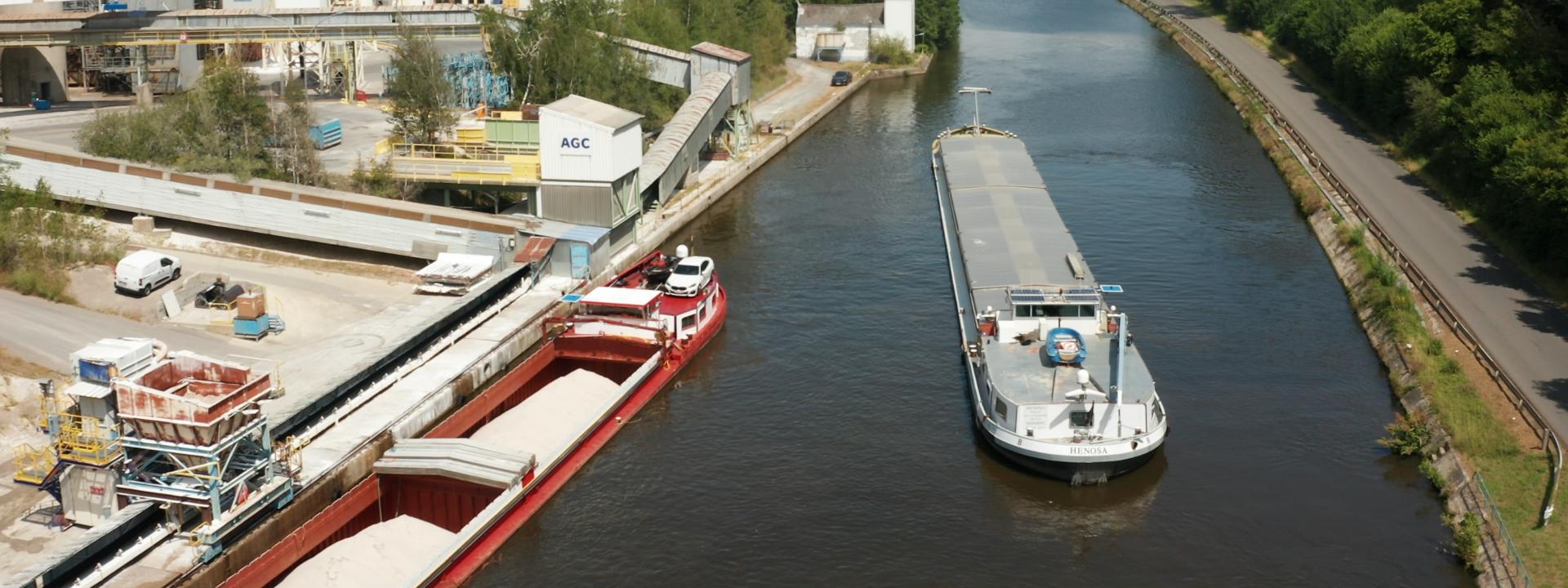
- Prioritizing Local Sourcing: We minimize transport distances by favoring local supply chains, as demonstrated by our sand sourcing strategy.
- Shifting to Mass Transport: We invest in and maintain infrastructure at our plants to favor transport methods like barges and trains over trucks. These methods generate significantly lower emissions (CO2, NOx, SOx, and dust) and help reduce road congestion.
- Optimizing Trucking Efficiency: When truck transport is necessary, we enhance its efficiency by avoiding dedicated trucks, thereby minimizing empty return trips.
- Collaborating with Suppliers: We are engaging with our transport suppliers (maritime, truck) to monitor the CO2 emissions related to their shipments and collaborate on reduction strategies, such as the use of biofuels (HVO) or electric trucks.
Strategic selection of Soda Ash
Soda ash is our second-largest raw material by volume but the primary contributor to our carbon footprint. Its carbon impact varies significantly based on several factors:
- Production Method: Whether it is produced via the synthetic Solvay process or derived from natural trona.
- Logistics: The distance it is transported.
- Process Efficiency: The use of low-carbon technologies in its production, such as biomass, renewable electricity, or high-efficiency steam generation.
This strategic selection is a key enabler for our Low-Carbon Glass range, which is manufactured using soda ash with a verified reduced carbon footprint.

Chemical Management and
compliance with REACH regulation
REACH Regulation has entered into force more than fifteen years ago and has developed continuously. It organizes the management of chemicals in the European Economic Area, to ensure a high level of protection of human health and the environment. REACH stands for Registration, Evaluation, Authorisation and restriction of CHemicals. It requires for example that chemical substances manufactured, imported, or used in Europe must be registered, gathering sufficient information for safe use. It requires also that information on substances must be communicated up and down the supply chain.
Registration & role of AGC Glass Europe as article producer
The final products that AGC Glass Europe puts on the market and supplies are not substances or mixtures, but articles. Articles are not entitled to be supplied together with a Safety Data Sheet, so this also applies to AGC Glass Europe products.
The glass itself, which is the basic constituent of AGC Glass Europe products, is exempted from registration following Annex V.11.
AGC Glass Europe is mainly a downstream user of substances and mixtures, in order to produce its own products. In this case, AGC Glass Europe ensures that its suppliers have registered their substances and are following REACH Regulation.
SVHC on the Candidate List for Authorisation, substances tracking and information in the supply chain.
AGC Glass Europe has a long-time policy of avoiding as much as possible the presence of dangerous substances in its products. However, if a SVHC in the Candidate List is present in a concentration above 0,1% w/w in an AGC Glass Europe product or in one of its parts (sub-article), AGC Glass Europe would provide the recipient of the product with all the relevant information pursuant to article 33.1 of REACH Regulation.
Also, if it would happen that the conditions of article 7.2 of REACH Regulation are met, AGC Glass Europe would notify the Agency accordingly.
Restrictions under REACH Regulation
Annex XVII of REACH Regulation contains the list of restricted substances, specifying which uses are restricted. AGC Glass Europe takes great care to comply with those restrictions, according to article 67.
More on our decarbonisation journey

Increasing the use of cullet
Glass is endlessly recyclable like no other product. Our main objective is to use as much glass cullet as possible in our production processes. The use of cullet avoids CO2 emissions, since cullet requires less energy to melt, and replaces carbonated raw materials. Cullet is a key material to save natural resources and energy.
AGC Glass Europe to incorporate Eastman’s Saflex™ LiteCarbon™ Clear interlayer into Low-Carbon Stratobel Glass
The integration of Eastman's Saflex™ LiteCarbon™ Clear interlayer into AGC's Low-Carbon Stratobel Glass represents a significant step forward in reducing the embodied carbon of laminated glass products.
