

Life Cycle Analysis
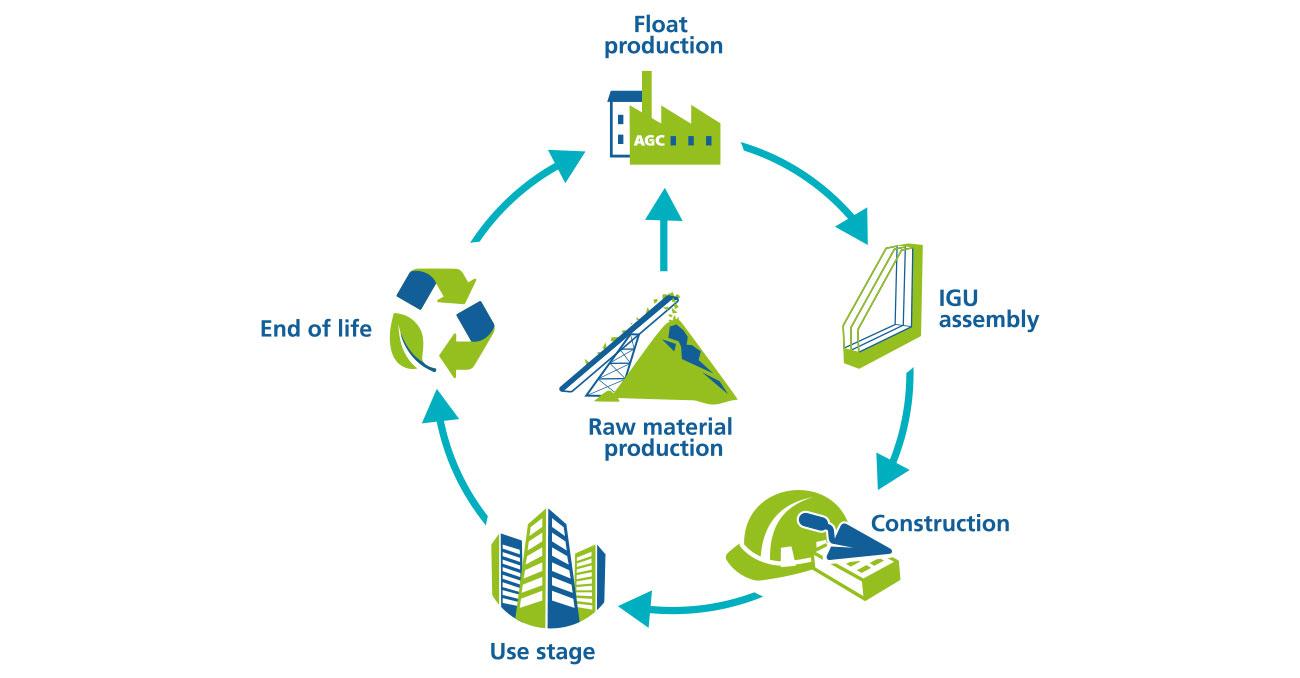
Life Cycle Assessment (LCA) is an internationally accepted, scientific tool (compliant with ISO 14040 & ISO 14044) used to quantify the environmental performance of a product across its different life stages, including upstream stages such as raw material production and energy supply.
LCA is a standardized methodology that aims to assess the potential environmental impacts of a product. It is based on all the inputs and outputs involved during the product’s manufacturing, as well as upstream and downstream processes, including supply chain, packaging, transport, use and end-of-life.
Conducting LCA for our products allows us to update our EPDs and align them with the latest European standards.
Environmental Product Declaration
An Environmental Product Declaration (EPD) is a way of providing science-based, verified, and comparable environmental information. It is a comprehensive and concise disclosure of a product’s environmental impact, based on the results of a full LCA. EPDs follow international standards, including ISO 14044 and ISO 14025. Furthermore, EN 15804 provides the core rules for creating EPDs for building products, which is complemented for glass products by the product category rule EN 17074:2019.
AGC Glass Europe fully recognises the need for such harmonised approach, which is accepted by the industry, the public sector and non-government organisations worldwide. The use of EPDs as best practice has been recognized and is internationally supported by the industry and the EU Commission, where the Construction Products Regulation (EU) No 305/2011 specifies that EPDs should be used when available. Companies and organisations in countries all over the world are working to improve the system.
Additionally, the requirement for third-party verification confirms the robustness of the underlying calculations.
In a product’s EPD, its climate impact, called Global Warming Potential (GWP), expressed in kg of CO2 eq. per functional unit, is the most scrutinized indicator. However, an EPD is more than that, covering the overall potential environmental impact of the product with 26 other indicators, such as the primary energy consumption (GWP correlated) or NOx and SOx-related air pollution (acidification and photo-oxidant formation ‘smog’).
Benefits of the Environmental Product Declarations:
- Life cycle approach
- Transparent disclosure of environmental information
- Independent verification.
EPDs also provide designers and architects with a way of identifying and assessing the potential environmental impacts associated with building/construction materials, products and building systems.
Within sustainable building schemes such as LEED and BREEAM, credits can be earned by using products that have EPDs (or related information) in building design and construction. Since LEED and BREEAM apply to sustainable building projects, individual products can contribute to gather points:
- For BREEAM, 6 points are available in the category “Mat 01 Life Cycle Impacts” for considering a “low environmental impact over full building life cycle” and in which 1 credit is earned directly if the building products have an externally verified EPD.
- Regarding LEED, a specific point is available to encourage the use of products and materials for which life-cycle information is available. With our EPDs, projects can thus meet the LEED disclosure criteria “MR – Building Products Disclosure and Optimization – Environmental Product Declarations”.
The regulatory framework is also pushing the development of LCA at building level for coming projects. Following the latest revision of the Energy Performance of Building Directive, new requirements for large-scale constructions are introduced. Starting in January 2030, all new buildings over 1,000 m² must calculate and disclose their life-cycle global warming potential (GWP) in their energy performance certificates (EPCs), as reported by the European Commission.
Such calculation is based on construction materials EPDs. Several countries have introduced the need for such calculation for new projects respecting some criteria : France with RE2020, Denmark, Netherlands, Finland, Sweden, and Germany.
For instance, the French RE2020 regulation mandates the calculation of the 27 indicators of the EPD and maximal admissible limit for GWP decreasing over time.
AGC Glass Europe EPD journey
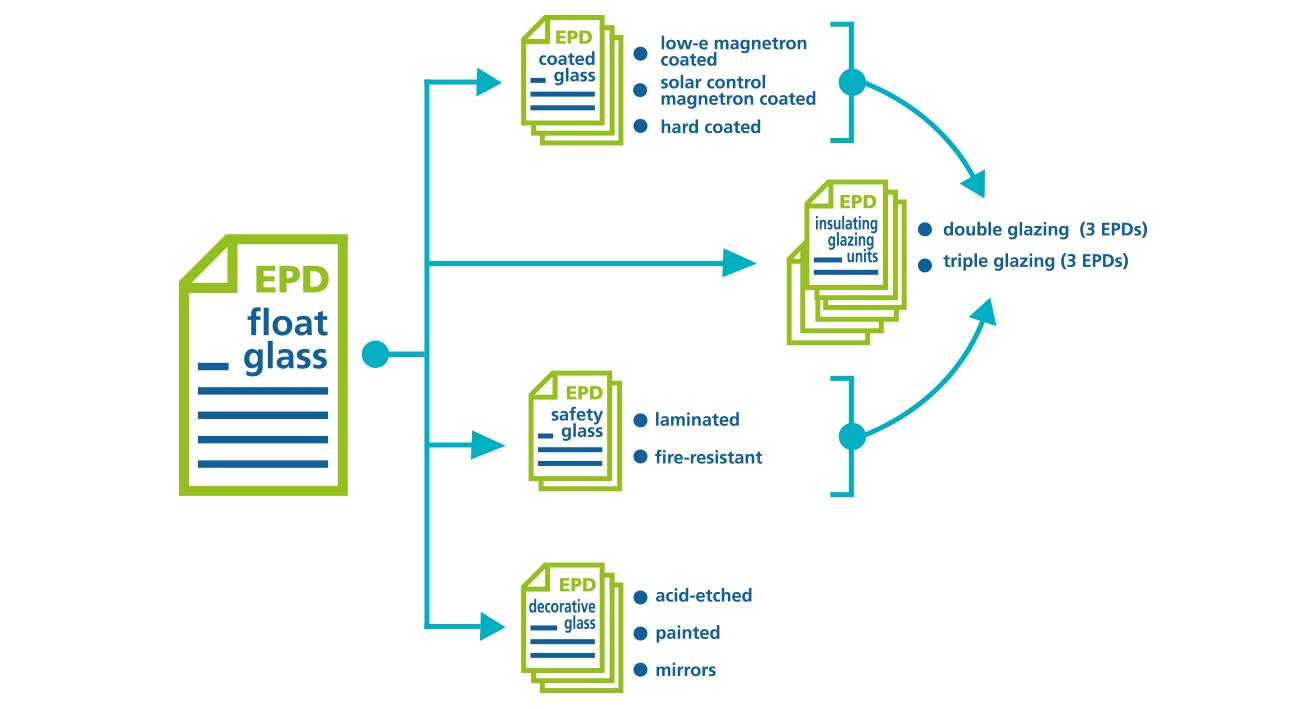
Our journey started in 2009, with the publication of our first EPD covering its main primary product: float glass. Since then, the EPD programme has been constantly broadened. EPDs for processed products such as coated glass, laminated glass or decorative glass, were drafted based on the float glass EPD. Final products such as Insulating Glazing Units are also covered, based on the respective EPDs of its glass components.
All our EPDs benefit from third party verification that distinguishes the stewardship of our products in a way that customers recognise and accept. Most of our products are now covered by EPDs specific to AGC Glass Europe and third party verified. These EPDs are based on a dedicated data collection from all our plants, reflecting our exact processes and environmental performance.
AGC is proud to offer the EPD Generator, an innovative and unique tool that instantly generates third-party verified Environmental Product Declarations (EPDs). Fully integrated into our Glass Configurator, and covering more than 1,500 glass products, the tool provides on-demand, transparent data compliant with international standards.
AGC’s EPD Generator also covers many Low-Carbon products range. This integration allows for an immediate, on-demand comparison of the substantially lower environmental impacts of our Low-Carbon range compared with the standard range.
.
Please contact sustainability@agc.com for more information.
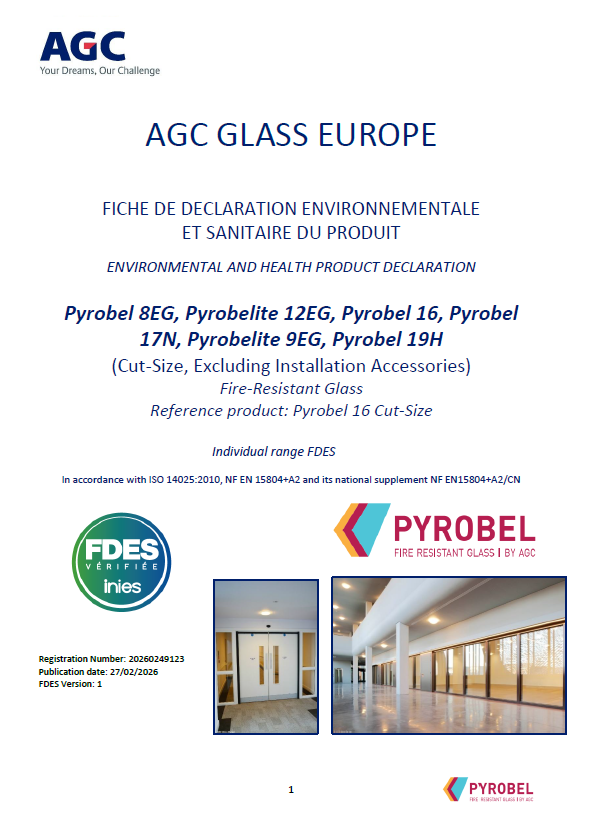
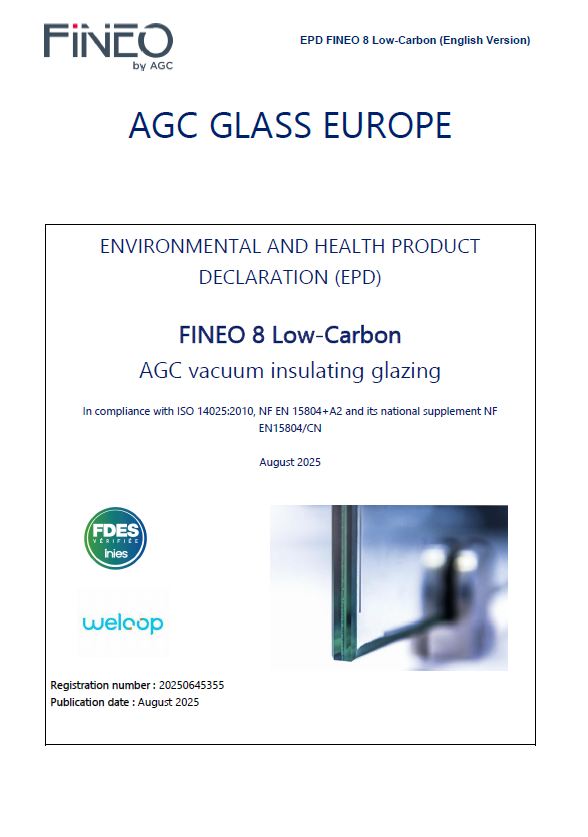
Our EPDs can also be found in Glass Configurator and in the French database for building products of the program operator INIES